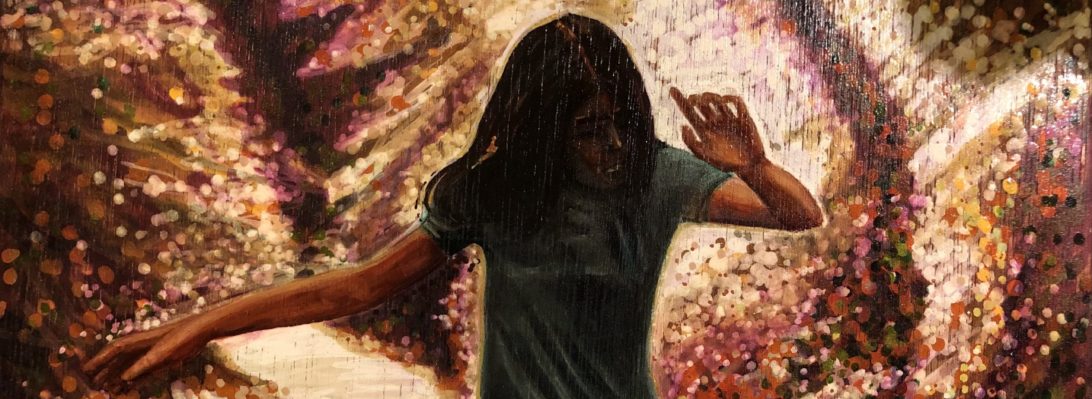
THE FATHER OF FANTASY & THE WIFE OF BATH:
by A. Emrys Huntington (Leiden Euniversity)

Although J.R.R. Tolkien in the course of his academic career focused more on the Old Germanic languages than on Middle English, he respected Chaucer’s “subtlety and flexibility” (Tolkien, Sir Gawain, p. 20) and “had a cultivated sympathy” (Shippey, The Road to Middle-Earth, p. 23) for him. In the course of this blog, I will endeavour to expand on the relevance of Chaucer’s Wife of Bath’s Prologue and Tale to Tolkien’s fiction and his ideas about writing fantasy or fairy-stories by exploring not merely their similarities, but also the reversals and contradictions.

Disclaimer:
To avoid excessiveness wordiness, I’m assuming most readers of this blog will have a general knowledge of The Lord of the Rings and an inkling of his Legendarium. If names are unfamiliar, the Tolkien Gateway is a good starting point.
I do fear that if Tolkien could read this blog, he might eschew its analysis as no more than “a shrewednes of apes,” a euphemism for his opinion on literary criticism (Essays, p. 12) as I am looking for similarities in Tolkien and Chaucer’s themes, narratives and characters. If possible, I will step out of camp Lit into camp Lang in the attempt. In his Valedictory Address, not only did Tolkien define the aforementioned camps, but also expressed astonishment at the use of erroneous translations of Chaucer within literary criticism, implying they lead to faulty conclusions. (p. 237) Therefore, within this blog Middle English will be used when citing from the Wife of Bath by line number. For those with no knowledge of ME, a line by line translation can be found here: 3.1 The Wife of Bath’s Prologue and Tale | Harvard’s Geoffrey Chaucer Website.
For those who wish to explore the Tale of the Wife of Bath visually, a relatively true to text animation can be found here:
ELVISHNESS: EXPERIENCE versus AUTHORITY
The first point to be made is that Tolkien read Chaucer extensively, was supremely capable of translating him, and, moreover, could recite large swaths of the tales from memory, both his 32nd letter and Bowers’ first and second chapters in Tolkien on Chaucer (TOC) corroborate this. Consequently, Tolkien could not have missed that in The Prologue of Sir Topas the Host describes Chaucer the pilgrim himself as “He semeth elvyssh by his contenaunce.” (l. 703) Similarly, when discussing the publishing of his Legendarium, Tolkien compares his style to that of the pilgrim poet in one of his letters:
Full of mythology, and elvishness, and all that ‘heigh stile’ (as Chaucer might say), which has been so little to the taste of many reviewers.
(Letter 182)
In Tom Shippey’s The Road to Middle-Earth (TRTME), linguistically Tolkien would agree that wherever the word had arisen that its usages were paradoxical and that it was difficult “to place them between the polarities of good and evil,” as it could be used in combinations spanning from “uncanny creature” to sacrifice” to “elf-beautiful.”(p. 66) Obviously, Tolkien’s Middle-Earth is populated with all sorts of elves, but as Bowers claims in the WoB’s Tale the “real protagonist is the Elf-Queen with her dancing ladies.” (Tolkien’s Lost Chaucer (TLC), p. 250)

The united elvishness of these two authors will return later in this blog, but to start we’ll go on a little philological journey beginning with how familial words convert to titles of respect, with the goal of connecting the authors to a famous wife of experience. The entry “father” reading from top to bottom in the online Oxford English Dictionary goes from the biological to the divine to superiors to originators to a “man who provides the most conspicuous, influential or archetypal example of something.” Consequently, Chaucer has been dubbed the father of English literature and Tolkien, likewise, the father of fantasy, albeit determining who exactly bestowed these titles is difficult to pin down. They certainly didn’t give them to themselves! Moreover, Tolkien most certainly did not view Chaucer in this paternal light, but as a sort of midway point:
I do not personally connect the North with either night or darkness, especially not in England, in whose long 1200 years of literary tradition Chaucer stands rather in the middle than the beginning. I also do not feel him springlike but autumnal (even if of the early autumn) and not kinglike but middle-class
(Letter 32)

The opposite could be said of Dame Alison who very clearly claimed the title of Wife herself, five times to be exact. Looking at the entry for wīf in the Middle English Compendium, it is quite evident that she meets almost all the senses and subsenses, which she discusses articulately and unabashedly in her prologue, especially to note being :“a woman;… the female partner in procreation, the mother…; the mistress of a household;…a stewardess (of property); the female partner in a sanctioned union, a wife; someone’s wife;… a woman who is or has been married; a woman who has had sexual experience, a woman who is not a virgin;… a cleric’s concubine or wife;… a concubine in a harem;… and with olde ~, an elderly woman; also used as a term of disparagement.”
In her prologue, the Wife of Bath (WoB) speaks, of course, not from titular, bookish authority but from experience, which “is right ynogh for me to speke…” (ll.1-2), in order to determine what is true knowledge about the woe and joy in marriage. John M. Bowers (a specialist in medieval literature) in TLC posits that Elrond’s eye-witness account and Gandalf’s deep dive into the archives and scrolls of Minas Tirith mirror these “medieval distinctions” in their attempt to reconstruct what happened to the ring after Isildur lost it. (p. 249)
THE FIRST FEMINIST ADVISES TOLKIEN ON SEXUAL RELATIONS

Chaucer and his works
With her numerous and detailed critiques of misogyny, there can be little doubt that the WoB is, in today’s terms, a feminist, whereas both Chaucer and Tolkien have been accused of the aforesaid. For evidence against the former, there is his letter to Bukton citing the WoB as a dire warning against marriage (Shippey, “Phallic,” p.1) and against the latter, there’s the “paucity of female characters” (Donovan, p. 106) built on “the most hackneyed of stereotypes” (Stimpton, p. 18) representing a “paternalism if not patriarchy (that is) unmissable.” (Curry, p. 127) just to mention a few. Others are kinder insisting “he was only reflecting his sources and his times,” (Crowe, p. 272) the same could be said of Chaucer a half millennium earlier.
So, how could these inveterate wife’s words of experience marry these possibly patriarchal poets? (Sorry, I couldn’t help the alliteration!)
Well, as Bowers points out “the poet (Chaucer) was never far from his (Tolkien’s) mind.” Furthermore, Tolkien in a letter to his son regarding marital and sexual relations repeatedly referred to and eventually cited from the WoB (TOC, p.181), “Allas, allas! That evere love was synne!” (l. 1009). What is even odder is as Tolkien goes on to describe ideal marriages to his son the similarities to the the WoB multiply (although while arguing essentially for chastity, Tolkien utilizes a contradiction to prove it):
Nearly all marriages, even happy ones, are mistakes: in the sense that almost certainly (in a more perfect world, or even with a little more care in this very imperfect one) both partners might have found more suitable mates. But the ‘real soul-mate’ is the one you are actually married to. You really do very little choosing: life and circumstance do most of it (though if there is a God these must be His instruments, or His appearances). It is notorious that in fact happy marriages are more common where the ‘choosing’ by the young persons is even more limited…
(Letter 43)
Obviously, the young knight views the marriage as a mistake (“My love?” quod he, “nay, my dampnacioun! (l. 1067) and the old hag as unsuitable (“Allas, that any of my nacioun/ Sholde evere so foule disparaged be!” (ll. 1068-9) and the only one doing the choosing is her: “Thanne have I gete of yow maistrie,” quod she, / “Syn I may chese and governe as me lest?” (ll.1236-7). Tolkien concludes the letter by essentially telling his son not to follow his example of an “exceptional” and “imprudent” courtship of a woman older than him as it disturbed his “throes of work for (a very necessary) Oxford scholarship.” (Letter 43) As knowledgeable as Tolkien was, it is nearly impossible to imagine him writing this and not recognizing the similarity to Alison and her 5th husband, the clerk of Oxford. Jane Chance points out:

It is perhaps no accident that Edith Bratt, as the beloved whom he chose as wife, was several years older than he and represented to him a recovery of the kind of safety and comfort of home; it is their relationship that he projects into that of the man Beren and the Half-elf Lúthien in The Silmarillion and it is their names that appear on his and Edith’s tombstones in Oxford.
(Chance, p. 20)
If Edith and Luthien can be compared to each other and the old hag is the Elf Queen, then “the comfort of home” above may be reminiscent of the knight’s “But hoom he gooth; he myghte nat sojourne;/ The day was come that homward moste he tourney”(ll. 987-8) just before he first encounters the old hag on the edge of the forest.
BEAUTIFUL and PERILOUS
Tom Shippey near the end of his essay The Bourgeois Burglar in The Road to Middle Earth concludes that Tolkien “did not work from ideas, but from words, names, consistencies and contradictions in folk-tales…” (p. 105). One of those inconsistencies (partially mentioned earlier in his essay) was about the disparity between the expressions with the word elf in Old Germanic languages and between the various retellings of Elf-Human romances in which “allure and the danger are mixed.” Not only are elves beautiful and perilous but they may be “sexually… rapacious,” for example:
…at the start of The Wife of Bath’s Tale Chaucer makers a series of jokes about elves and friars, the burden of which is that the latter are sexually more rapacious than the former, though the former had a bad reputation with young women as well. (p.67)

It can be explained that the WoB influenced Tolkien’s creation of his far more chaste couplings of Lúthien and Beren and Aragorn and Arwen by exploring these contradictions in other characters. Shippey provides the example in The Two Towers of Sam Gangee’s reply to Faramir saying that Galadriel must be “perilously fair”:
I don’t know about perilous,’ said Sam. `It strikes me that folk takes their peril with them into Lórien, and finds it there because they’ve brought it. But perhaps you could call her perilous, because she’s so strong in herself. You, you could dash yourself to pieces on her, like a ship on a rock; or drownd yourself, like a hobbit in a river. But neither rock nor river would be to blame. (IV.5)
While Shippey compares the above to other medieval fairies, Sam’s explanation could be applied to both Dame Alison and the old hag/Elf Queen in her tale, as both woman are strong to the point of domination, while it is, like Sam says, the Knight who has “taken his own peril” with him through his actions of rape and rash promises.
In The Fairy Way of Writing, Kevin Pask’s claim that Galadriel “is of particular interest…because Tolkien clearly establishes her as the precursor of the mysterious and enchanting fairies who entered the mainstream of European literature with the medieval romance” (Pask, p. 138) supports this take.
Although no reader of LOTR doubts Galadriel’s beauty, within the mythology of Middle-Earth Eomer of Rohan has a far more perilous image of her in his mind, “Then there is a Lady in the Golden Wood, as old tales tell!…Few escape her nets, they say….But if you have her favour, then you also you are net-weavers and sorcerers, maybe.” (III.2). Nets and net-weavers associate her with the Fates or the Norns, but also the monstrous web-weaving Shelob. Mythologically in the minds of the Men of Middle Earth, Galadriel has the ability to shapeshift into something monstrous, just as the old hag can revert at will to her fairy queen form. This recalls, “The trouble with the real folk of Fairie is that they do not always look like what they are” from Tolkien’s essay On Fairy Stories. (p.113) In reference to the passage before, Bowers points out that the “knight fails to recognize the Elf Queen” much like Tolkien’s Smith of Wootton Major has an “Elf Queen in disguise.” (TLC, p. 25)
                 As evere was wyf, syn that the world was newe.
                 And but I be to-morn as fair to seene
                 As any lady, emperice, or queene,
                 That is bitwixe the est and eke the west,
                 Dooth with my lyf and deth right as yow lest.
                 Cast up the curtyn, looke how that it is."
                  And whan the knyght saugh verraily al this,
                 That she so fair was, and so yong therto,
                 For joye he hente hire in his armes two.
                 His herte bathed in a bath of blisse. (ll. 1244-1253)
I would also argue that Chaucer’s “queene” being between East and West (which is echoed by Life and Death in the next line) could serve as a snippet of elder lore in the creation of Galadriel and Arwen. Luthien, Arwen’s predecessor, whose beauty “was as the dawn in spring” (Silmarillion, Ch. 10) also has “the arts” to shapeshift into “the winged fell of Thuringwethil…a bat-like creature clinging with creased wings.” As Luthien was “the most beautiful of all the Children of Ilúvatar,” it is remarkable that Tolkien transformed her into an old bat, a derogatory term for an elderly woman. However, her disguise did not last long as “casting back her foul raiment she stood forth, small…, but radiant and terrible.” (Silmarillion, Ch.19). Even though Arwen is no shapeshifter, she changes after Aragorn’s death “the light of her eyes was quenched, and it seemed to her people that she had become cold and grey as nightfall.” Her return to the abandoned forest of Lothlorien seems a reversal of the knight’s first meeting with the loathly lady near “a forest syde…No creature saugh he that bar lyf, Save on the grene he saugh sittynge a wyf –…And seyde, “Sire knyght, heer forth ne lith no wey.” (ll. 990, 997-98, 1001)

SHELOB’S INSATIABLE SEXUALITY

Although the old hag has returned to her illustrious form at the end of the tale, the last line implies a blissful (i.e. sexual) comingling. While Tolkien framed most of his female characters as noble and idealized, none of them spoke openly about their sexual relations and all except one were “purged of the(ir) sexual peril” (Pask, p. 139). However, while the framing of “old women as insatiable monsters of sex has a long history, and one with which Tolkien was again intimately familiar…, Shelob bears—in and on her own female body—these horrors of old age and sexual deviancy into the world of The Lord of the Rings.” (Miller, p. 143). Shelob may well be Tolkien’s reworking of the loathly lady, and by extension, the WoB herself. The simple etymology of Shelob is explained in a letter to his son Christopher:
Do you think Shelob is a good name for a monstrous spider creature? It is of course only ‘she+lob’ (= spider), but written as one, it seems to be quite noisome….
(Letter 70)
At first glance, Shelob seems no more than her name, a big female monster. However, in The Two Towers when Sam and Frodo enter her lair, the vocabulary surpasses that used for horror and verges on perversity. Tolkien worked extensively on The Reeve’s Tale, quite possibly Chaucer’s raciest tale. However, as Miller points out, he “bowdlerized” the translation removing the rapes, the “priking” and the “swiving,” arguing that this imagery resurfaced in Sam’s “quasi-sexual encounter with the great and ancient mother Shelob.” (p. 150-151) If this is a source for the horror-eroticism of the gigantic spider with two hobbits, then the sexual explicitness of the WoB’s prologue and the Tale’s rapist getting his come-uppance (by having to submit to the sovereignty of the loathly lady) may be as well.
According to Miller, Shelob’s lair is repeatedly described with anatomically suggestive words and phrases such as “dark hole,” “cleft,” and, finally, “that cursed crack of hers.” (p. 136-7) Moreover, it also exudes “a foul reek, as if filth unnameable were piled and hoarded” within. As Gollum enters, he’s “hissing and gasping” and Sam and Frodo are “groping” with “a desire to come at last to the high gate beyond.” They continue to “thrust” forward. The light from Galadriel’s Phial is described by its “potency” and growth, but when Frodo wavers, “slowly the Phial drooped.” When they finally reach the exit to the cave “panting, yearning” the description of its impenetrable cobweb covering could be likened to a hymen. Her hunger is not described as gluttony, but as lust: “her lust was not his lust” and “she lusted for sweeter meat.” (IV.9)

Remarkably, Frodo is described as being “in a fey mood” while trying to evade Shelob, the “most loathly shape ever beheld.” Shelob is the extreme of the loathly lady with “her huge swollen body, a vast bloated bag, swaying and sagging between her legs.” (IV.9) Miller refers to Shelob as having a phallus of her own “un-spiderlike sting, a kind of (transgressing).” (p. 135) The emphasis on her nether regions “before she could sink upon him, smothering him and all his little impudence of courage” continues to a premature climax where “Now splaying her legs she drove her huge bulk down on him again. Too soon.” Likewise, the WoB repeatedly refers to lust, her pudendum, lechery, loose foreskin, ugly women leaping on men like dogs, and said she “koude noght withdrawe/My chambre of Venus from a good felawe” (ll. 617-8) echoing the climax in Shelob’s lair. Is Tolkien unconsciously trying to one up Dame Alison’s audacity (and thereby Chaucer’s) just as he did with the prophecies in Shakespeare’s Macbeth and the Ents?
I daresay something had been going on in the ‘unconscious’ for some time, and that accounts for my feeling throughout, especially when stuck, that I was not inventing but reporting (imperfectly) and had at times to wait till ‘what really happened’ came through. But looking back analytically I should say that Ents are composed of philology, literature, and life. They owe their name to the eald enta geweorc of Anglo-Saxon, and their connexion with stone. Their pan in the story is due, I think, to my bitter disappointment and disgust from schooldays with the shabby use made in Shakespeare of the coming of ‘Great Birnam wood to high Dunsinane hill’: I longed to devise a setting in which the trees might really march to war.
(Letter 163)
THE DANCING ROAD TO FAIRIE

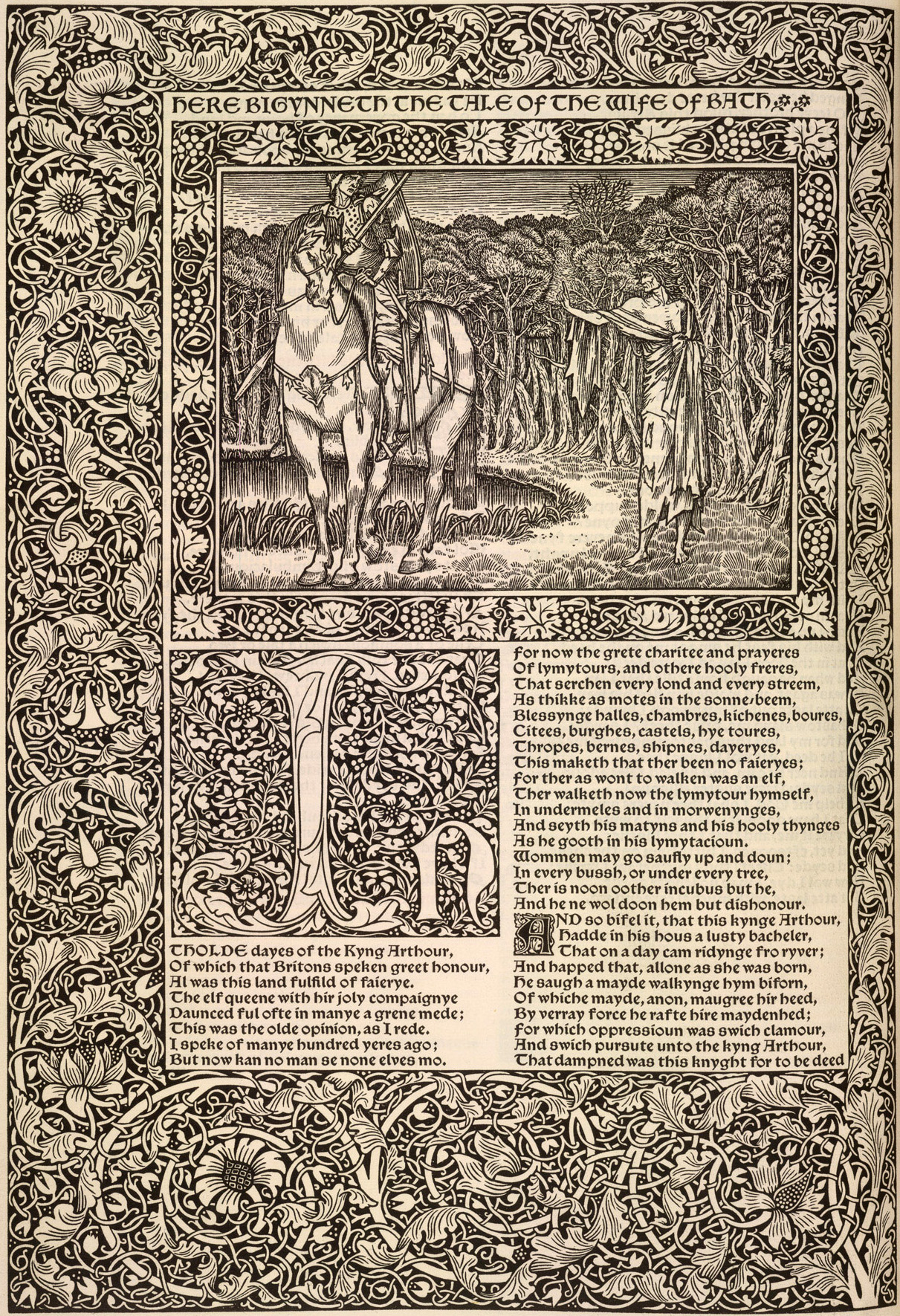
In TLC, Bowers links the WoB’s “account of fairies and their disappearance” to “figures of elder myth” calling it “a deep-rootedness which Tolkien valued.” (p. 249-250) In On Fairy-Stories, Tolkien recounts how even an unimportant historical Arthur, can “emerge as a King of Faerie” (p. 126) when reading the opening lines of the WoB’s Tale:
 In th' olde dayes of the Kyng Arthour,
 Of which that Britons speken greet honour,
 Al was this land fulfild of fayerye.
 The elf-queene, with hir joly compaignye,
 Daunced ful ofte in many a grene mede.
 (ll. 857-861)
In Solopova’s chapter on Middle English in A Companion to JRR Tolkien, she cites Shippey’s observation that Tolkien previously used the word “fairy” “including in The Hobbit, but then abandoned it as a foreign word with a confused history in favour of the Germanic word ‘elf’,”(p. 241), but links that to the above passage which uses both the French-derived fayerye and the Germanic elf, implying that this shift would have interested Tolkien as a philologist.
Also in these opening lines, the motif of dancing elves was important to Tolkien both in a personal memory of his wife dancing and creatively when Beren first meets Lúthien in The Silmarillion and when Aragorn chanted the tale of Tinúviel on Weathertop in The Fellowship of the Ring (TLC, p. 250-1):
The leaves were long, the grass was green,
The hemlock-umbels tall and fair,
And in the glade a light was seen
Of stars in shadow shimmering.
Tinúviel was dancing there
To music of a pipe unseen
…
Through woven woods in Elvenhome
She tightly fled on dancing feet,
And left him lonely still to roam
In the silent forest listening.
…
Her mantle glinted in the moon,
As on a hill-top high and far
She danced, and at her feet was strewn
A mist of silver quivering. (I.11)

While the above poem ends with Tinúviel dying in Beren’s arms, the end of the WoB’s tale with its dancing fairies ends happily:
And thus they lyve unto hir lyves ende
In parfit joye;.… (ll. 1257-8)
Bowers theorizes that the above lines, which were a casual hint by Chaucer that “the Elf-Queen sacrificed her immortality for the love of a mortal man,” were the inspiration for Arwen’s sacrifice for Aragorn and other Elf-Human marriages (TLC, p. 252), like Beren and Luthien. Moreover, he explains that the WoB’s Tale is a “reversal of the Breton Lay, Lanval.” (TLC, p. 251) Remarkedly, the tale of Beren and Luthien in The Silmarillion is referred to as a “the Lay of Leithian” and also concludes with Luthien also choosing a mortal life and its inevitable end “in which amid weeping there is joy.” (Ch.19)
VANISHING ELVES

The disappearance of elves is both at the start “But now kan no man se none elves mo,” (l. 864)
and near the end of the WoB’s Tale “But certeinly, er he cam fully there,/ Vanysshed was this daunce, he nyste where./No creature saugh he that bar lyf,” (ll. 995-7). In contrast to Tolkien’s fiction in which the ultimate departure of the Elves to the Undying Lands is caused by the Age of Men, Chaucer’s disappear due to the prevalence of friars. Nevertheless, one could argue that these friars in the clear violation of their vows, “And he ne wol doon hem but dishonour” (l.881)and by the list of all the human places they have also overrun (see lines 869-71) are representative of mankind. This contrast of honourable elves and dishonourable men (e.g. friars are compared to evil spirits “incubus” (l. 880) and the rapist-knight broke the code of chivalry) is echoed in Tolkien’s letter disclaiming that the LOTR was an allegory for Atomic Power:
Death and Immortality: the mystery of the love of the world in the hearts of a race ‘doomed’ to leave and seemingly lose it; the anguish in the hearts of a race ‘doomed’ not to leave it, until its whole evil-aroused story is complete.
(Letter 186)
Furthermore, the ease with which the magic needed to coalesce 24 dancing ladies into one Elf-Queene disguised as an old hag adheres to Tolkien’s tenet on how magic should be in On Fairy Stories in his essays: “taken seriously, nether laughed at nor explained away.”(p. 114) In a similar manner to Alison’s statements of the friars overrunning the world, “But now kan no man se none elves mo” (l. 864) and “this maketh that ther ben no fayeryes.”(l. 872), Galadriel explains the seriousness of the vanishing of elves:
Do you not see now wherefore your coming is to us as the footstep of Doom? For if you fail, then we are laid bare to the Enemy. Yet if you succeed, then our power is diminished, and Lothlórien will fade, and the tides of Time will sweep it away. We must depart into the West, or dwindle to a rustic folk of dell and cave, slowly to forget and to be forgotten.'(II.7)
Whereas according to Bowers the Arthurian Romances’ Fairie was “too lavish and fantastical…, the Wife of Bath’s Tale provided a corrective. Her fairies are fleeting and mysterious, and the old hag’s true identity as the Elf-queen never explicitly stated.” (p. 252)
BACK TO MIDDLE EARTH
On a less magical note, Jane Chance links the Loathly Lady’s speech to the knight on gentilesse (ll. 1109-1176) to Tolkien’s sensitivity to “classist presumptions.” (p. 149). The truehero of LOTR can with no doubt be the humble Samwise Gamgee, Frodo’s loyal servant, who not only nobly carries Frodo when he no longer can bear the weight of the ring, but is also capable of relinquishing the ring and its power. “He is gentil that dooth gentil dedis”(l.1170) could describe Sam. Although Tolkien feels the theme of power is of lesser importance than “Death and Immortality” in the LOTR (Letter, 186), it resonates on two levels in his work and the WoB’s Tale. Both the reversal of social class which undermines the established order and the willing relinquishment of power is what is required for joy and peace, both in Middle-Earth and in an Elf-Human marriage.

Not only the WoB, but the entirety of the Canterbury Tales with its panorama of every medieval walk of life is reminiscent of what Tolkien’s says in On Fairy-Stories:
“… waiting for the great figures of Myth and History, and for the yet nameless He or She, waiting for the moment when they are cast into the simmering stew, one by one or all together, without consideration of rank or precedence.”
(Essays, p. 127)

While Chaucer has his pilgrimage to mingle the different classes of the Middle Ages, Tolkien snatches, at times with purpose at others unconsciously, snippets and reversals of the words, narrative, themes and characters of the Wife of Bath’s Tale and Prologue and casts them with so many nameless others in his pot to prepare his Middle Earth. These reversals include Tolkien’s and Chaucer’s linguistic affinity for elvishness over Fairie, their debates on experience versus authority, the trope of dancing fairies to vanishing elves, the counterargument of sexual rapacity for chastity, the duality of beauty and peril of shapeshifters and disguises, the relation of social class and gentilesse to the undermining of power, and, finally, the overarching theme of death and immortality. Although their finished soup is by no means the same and their ingredients vary, these “Cooks (did) not dip in the ladle quite blindly. Their selection is important.” (Essays, p. 128)
THE END
Bibliography
Bowers, John M., “Tolkien’s Lost Chaucer,” Oxford University Press, 2019
Bowers, John M., and Peter Steffensen. “Tolkien on Chaucer, 1913-1959.” 1st ed., Oxford University Press, 2025. Accessed 05 November 2025.
Chance, Jane. “Tolkien, Self and Other:’This Queer Creature.’” 1st ed. 2016., Palgrave Macmillan US, 2016, doi.org/10.1057/978-1-137-39896-3, Accessed 05 November 2025.
Chaucer, Geoffrey, “Harvard’s Geoffrey Chaucer Website: 3.1 The Wife of Bath’s Prologue and Tale,” chaucer.fas.harvard.edu/pages/wife-baths-prologue-and-tale-0, Accessed 05 November 2025.
Crowe, Edith L. “Power in Arda: Sources, Uses and Misuses.” Reynolds and GoodKnight 272–77. Reprinted in this volume. Accessed 05 November 2025.
Curry, Patrick. “’Less Noise and More Green’: Tolkien’s Ideology for England.” Reynolds and GoodKnight 126–38. Accessed 05 November 2025.
Donovan, Leslie. “The Valkyrie Reflex in JRR Tolkien’s The Lord of the Rings: Galadriel, ….” Chance, Chance. Accessed 05 November 2025.
“Middle English Dictionary.” Ed. Robert E. Lewis, et al. Ann Arbor: University of Michigan Press, 1952-2001. Online edition in Middle English Compendium. Ed. Frances McSparran, et al. Ann Arbor: University of Michigan Library, 2000-2018. <http://quod.lib.umich.edu/m/middle-english-dictionary/>. Accessed 05 November 2025.
Miller, T. S. “Tolkien and Rape: Sexual Terror, Sexual Violence, and the Woman’s Body in Middle-Earth.” Extrapolation, 2021. Accessed 05 November 2025.
Oxford English Dictionary. Oxford University Press, 2000, www.oed.com.
Pask, Kevin. “The Fairy Way of Writing: Shakespeare to Tolkien,” Johns Hopkins University Press, 2013.
Shippey, Tom. “Phallic, Ocular and Other Aggressions in Chaucer’s Canterbury Tales and Their Analogs.” Accessed 05 November 2025.
Shippey, Tom, “The Road to Middle-Earth: How J.R.R. Tolkien Created a New Mythology,” Harper Collins Publishers,1982
Solopova, Elizabeth. “Middle English.” A Companion to J. R. R. Tolkien, edited by Stuart D Lee, John Wiley & Sons, Inc, 2022, pp. 235–46, https://doi.org/10.1002/9781119691457.ch19. Accessed 05 November 2025.
Stimpson, Catherine R., “J. R. R. Tolkien. Columbia Essays on Modern Writers, vol. 41.” New York: Columbia UP, 1969. Print.
Tolkien, J.R.R., “The Fellowship of the Ring,” 1954, web.archive.org/web/20180706194611/https://www.ae-lib.org.ua/texts-c/tolkien__the_lord_of_the_rings_1__en.htm, Accessed 05 November 2025.
Tolkien, J.R.R, “The Letters of J.R.R. Tolkien: A selection edited by Humphrey Carpenter with the assistance of Christopher Tolkien,” web.archive.org/web/20190428174448/https:/timedotcom.files.wordpress.com/2014/12/the_letters_of_j.rrtolkien.pdf, Accessed 05 November 2025.
Tolkien, J. R. R., and Christopher Tolkien. “The Monsters and the Critics, and Other Essays,” Harper Collins Publishers,1983.
Tolkien, J.R.R., “The Silmarillion,” 1977, web.archive.org/web/20190323220935/http:/ae-lib.org.ua/texts-c/tolkien__the_silmarillion__en.htm#19, Accessed 05 November 2025.
Tolkien, J.R.R., “Sir Gawain and the Green Knight with Pearl and Sir Orfeo,” Harper Collins Publishers, 2021
Tolkien, J.R.R., “The Two Towers,” 1955, web.archive.org/web/20180710004322/http://www.ae-lib.org.ua/texts-c/tolkien__the_lord_of_the_rings_2__en.htm, Accessed 05 November 2025.